


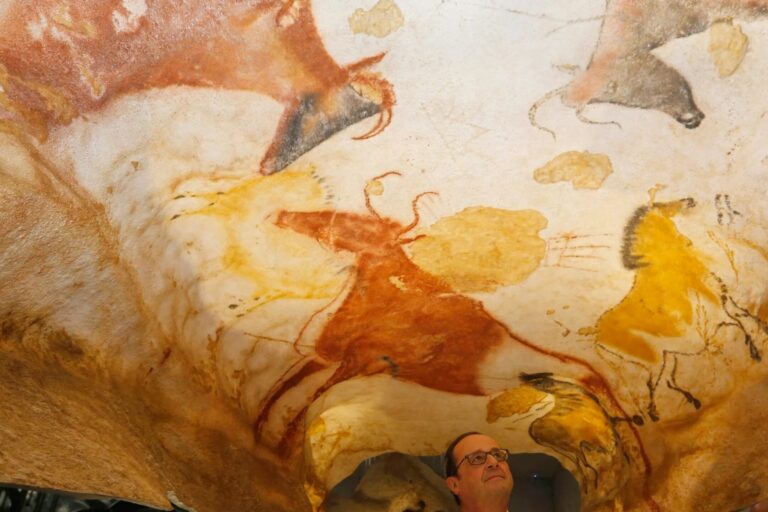
On September 12, 1940, a teenager and his dog stumbled upon a hole left by an uprooted tree in the village of Montignac, France. When he and his friends investigated further, they found a 50-foot tunnel leading to one of the most significant Paleolithic discoveries of all time: the Lascaux cave complex.
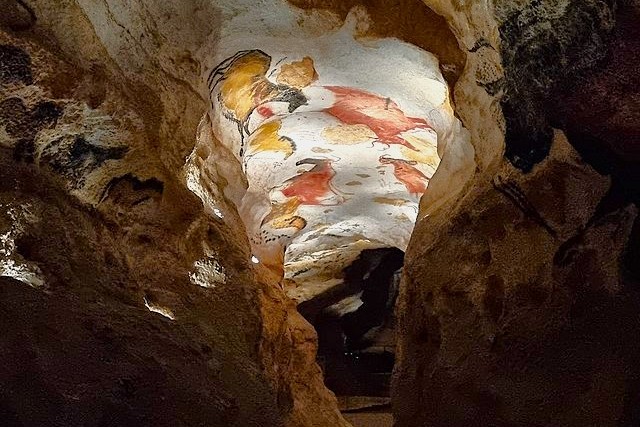
Interior of Lascaux IV, the scale replica of the original Lascaux cave complex
Over 600 paintings and 1,500 engravings of bison, stags, cattle, equines, and other large animals cover the walls and ceilings of the Lascaux caves, earning it the nickname of “The Sistine Chapel of Prehistoric Art.” The cave art dates as far back as 17,000 BCE, representing some of the oldest artistic traces in human history. The Lascaux caves prove that the humans alive during the last Ice Age valued not just survival, but also art and expression.
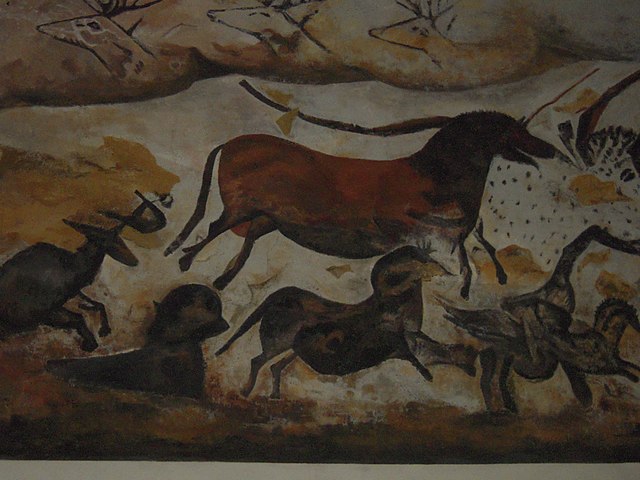
A close-up of one of the recreations of the cave paintings reveals the incredible skill and detail of these early human artists.
The original purpose of the caves continues to be debated; some historians theorize the images depict past hunting victories or were painted as part of a ritual to ensure future success in the hunt. We may never know the true reason behind the art; however, we are able to glean important historical knowledge from it, especially surrounding the evolution of human artistic ability.

“The Crossed Bison” in Lascaux IV
For example, a Lascaux painting called “The Crossed Bison” (pictured above) features some of the earliest artistic use of transparency and occlusion, where two figures overlap to create the illusion of depth.
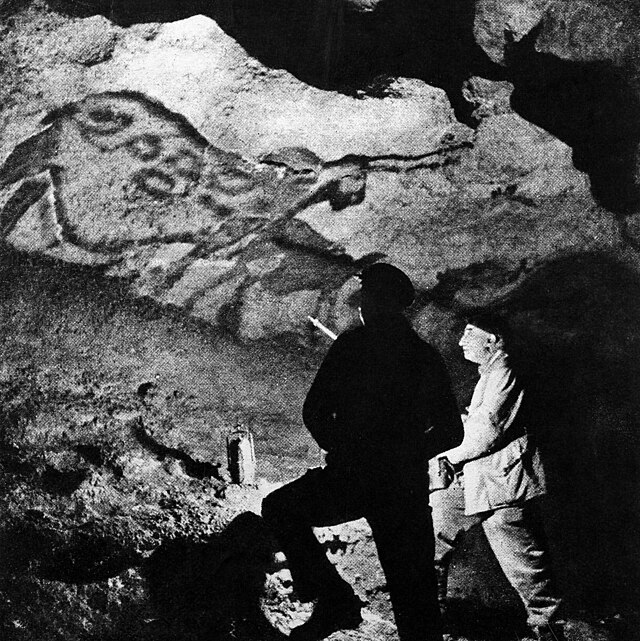
Archaeologist Henri Breuil (right) was one of the first to study the Lascaux cave paintings. Credit: “Abbe Breuil in Lascaux cave” by Wellcome Collection (CC BY 4.0)
Eight years after being discovered, the caves were opened to the public. Archaeologists and experts flocked to Lascaux – as did thousands of members of the general public. Some 1,200 visitors per day passed through the caves, and the paintings began deteriorating from exposure to heat, carbon dioxide, and humidity. Officials closed the site in 1963 in an attempt to salvage what remained.
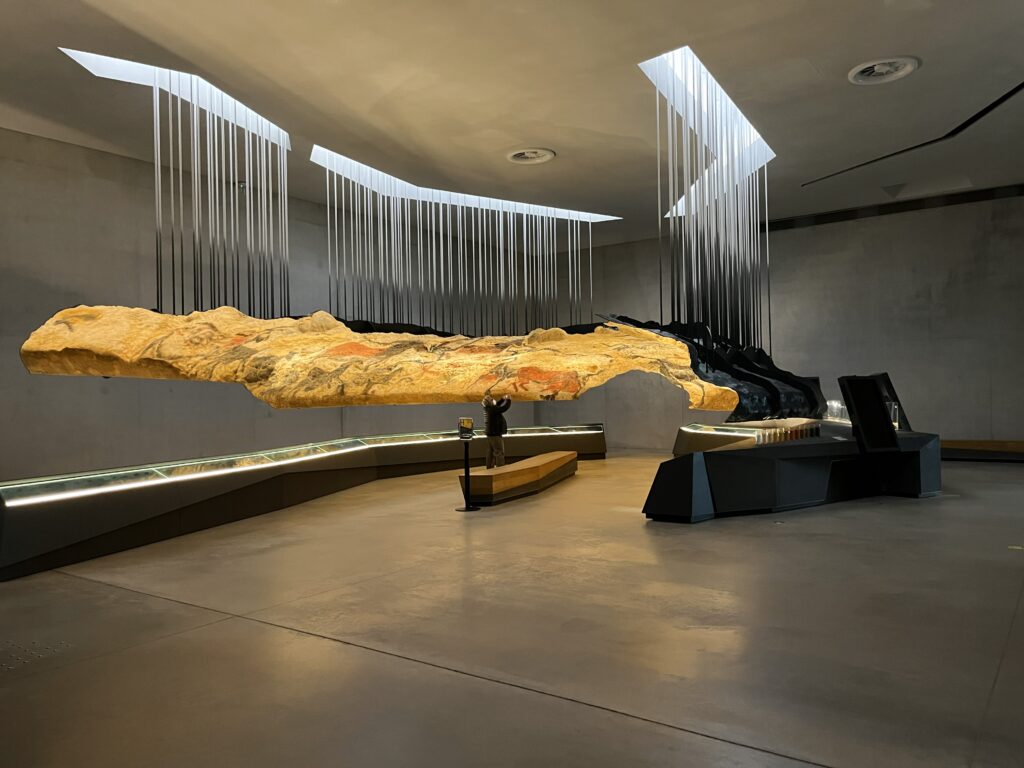
An exhibition of cave art on display at the Lascaux Center fo Parietal Art.
To allow people to enjoy this prehistoric wonder without threatening the integrity of the caves, conservationists began creating replicas. Lascaux II (1983) was the first, consisting of copies of some of the more famous paintings, such as “The Great Hall of the Bulls.” Then, in 2012, five exact reproductions of portions of the cave art were completed to be exhibited around the world – called Lascaux III. And lastly, a scale replica of the caves themselves – Lascaux IV – was constructed in 2016, along with the Lascaux Center for Parietal Art (pictured above). This museum allows guests to “enter” the caves and view the art as it was first discovered, without threatening the delicate remains of the original site.
You can immerse yourself in prehistory and visit Lascaux IV and the Lascaux Center for Parietal Art on our Provincial French Countryside small group tour. Just give us a call or submit your online reservation request today to save your spot.
Share your great adventures with us on social media. Tag your pictures with #myodyssey and they may be featured on our website!


By using this website you are agreeing to our Cookie Policy.

